


 Tiếng Việt
If you are just beginning your journey into the world of wine, you may have wondered: “How many bottles are in a case of wine?” The answer is not just a number. It opens up a fascinating story of history, economics and convenience that has shaped the global wine industry.
This article will be your guide to not only finding the exact answer to the question “How many bottles are in a case of wine?”, but also understanding “why”. After reading, you will be able to confidently explain why some wine cases contain 6 bottles, while others contain 12.
1. The modern standard: 6-bottle wine cases – The rise of practicality
If you walk into a wine shop today, especially in Vietnam, and ask to buy a “case of wine”, there is a high chance the seller will give you a case containing 6 bottles. This has become an extremely popular packaging format and is considered the “average” standard in the modern market. So why has the number 6 become so widely favored?
1.1. More accessible pricing
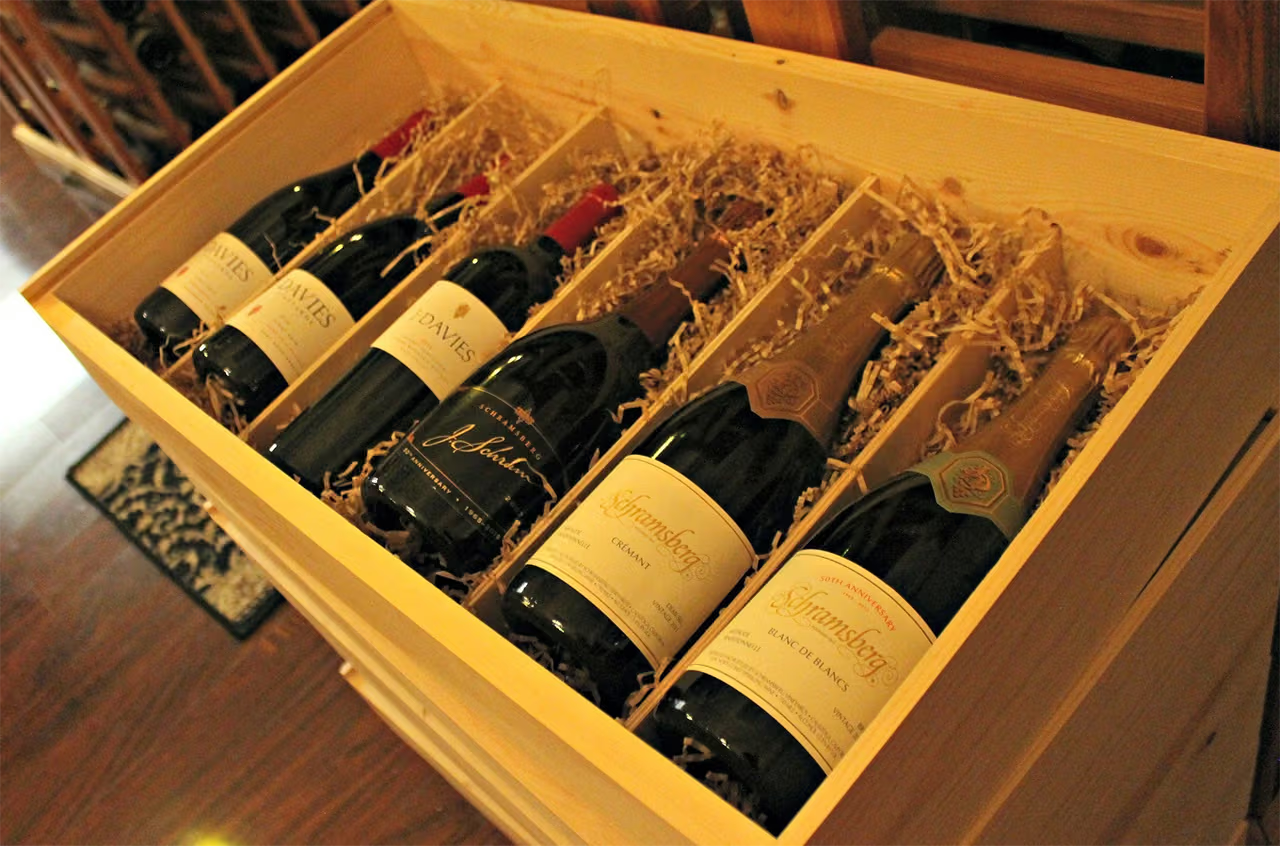
This is the biggest driving force. As the prices of quality wine bottles continue to rise, buying a full 12-bottle case can become a significant financial barrier. Wine producers, especially those making premium wines, have shifted toward 6-bottle cases to make their products more “accessible”. Instead of spending a large amount on 12 bottles, consumers can start with 6. This gives more people the opportunity to enjoy good wines that they may previously have hesitated to buy.
1.2. Convenient, compact and safe
Have you ever tried lifting a 12-bottle case of wine? It is quite heavy, potentially reaching up to 19 kg. Repeatedly moving such a heavy item is not easy and may carry the risk of injury. In contrast, a 6-bottle case weighs about half as much, around 9 kg, making transportation, loading, handling and carrying much safer and easier for everyone, from warehouse staff, delivery workers and restaurant employees to you yourself.
1.3. Optimizing storage space
This shift was initially driven by the needs of restaurants, especially in large cities where space is precious. A wine cellar with limited space can hold more wine varieties if they are packed in 6-bottle cases instead of 12-bottle cases. This allows restaurants to offer guests a richer and more diverse wine list. The same convenience applies to wine lovers at home, making it easier to organize their collections.
For these very practical reasons, the 6-bottle case has gradually become the new standard, especially popular for wines from Italy, Spain, California and Champagne, since Champagne bottles are already heavier than regular bottles.
2. The historic standard: 12-bottle wine cases – A legacy of international trade
Although 6-bottle cases are now dominant, the historic and foundational global wine industry standard is actually the 12-bottle case. A standard international case contains 12 bottles of
750ml, with a total volume of 9 liters of wine. The number 12 was not a random choice, but the result of a smart economic and logistical calculation from the 19th century.
2.1. The origin of the 12-bottle wine case: The story of Anglo-French trade
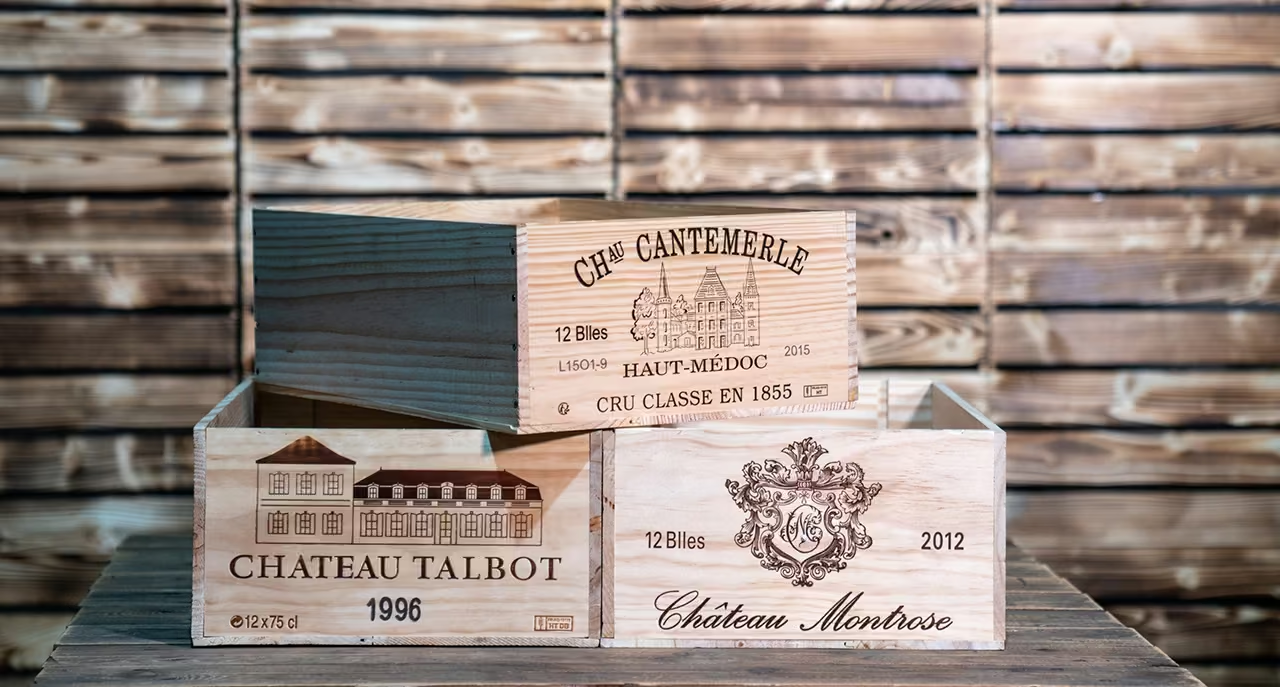
The origin of the 12-bottle case comes from the lively trade between Bordeaux in France, one of the world’s most prestigious wine-producing centers, and its biggest customer at the time: England.
The issue was that the two countries used different measurement systems. The French used the metric system, or liters, while the English used the Imperial system, or gallons. To make trade, shipping and especially taxation more convenient, they needed a common conversion unit.
The solution lay in the very oak barrels used to age wine. A standard Bordeaux wine barrel, known as a barrique, has a precise capacity of 225 liters. This number happens to be equivalent to about 50 Imperial gallons.
Producers realized that one 225-liter barrel could fill exactly 300 bottles of 750ml. From there, a perfect calculation was born: to make transport and trade easier, they decided to divide those 300 bottles into
25 smaller cases.
300 bottles ÷ 25 cases = 12 bottles per case.
And so the 12-bottle case was born, becoming a perfect subdivision of one barrique barrel. This calculation simplified everything, from ordering and inventory management to profit calculation.
2.2. The convenience of the number 12
Beyond its historical reason, the number 12 is also a “magical” number in commerce. It can be divided evenly by 2, 3, 4 and 6. This gave merchants great flexibility in selling wine. They could easily sell half a case, 6 bottles, one-third of a case, 4 bottles, or one-quarter of a case, 3 bottles, without having to separate bottles one by one. In terms of packaging, arranging 12 bottles in a 3×4 or 2×6 structure creates a sturdy rectangular box that is easy to stack on pallets for long-distance transport.
Therefore, the 12-bottle case is not merely a packaging choice. It is a legacy of trade history, an intelligent solution connecting two cultures and two different measurement systems.
3. What about other bottle sizes?
The world of wine is not limited to the standard 750ml bottle. You may encounter smaller bottles or “giant” bottles used for special occasions. Their case formats are also very interesting:
- Small bottles (Half-bottle, 375ml): These bottles, half the size of a standard bottle, are often packed in cases of 24 bottles or 12 bottles. A case of 24 bottles of 375ml also has a total volume of 9 liters, exactly equal to a standard 12-bottle case.
- Large bottles (Magnum, 1.5L): This is the most common large-format bottle, equivalent to 2 standard bottles. They are often packed in cases of 6 bottles. Once again, the total volume remains 9 liters (6 x 1.5L).
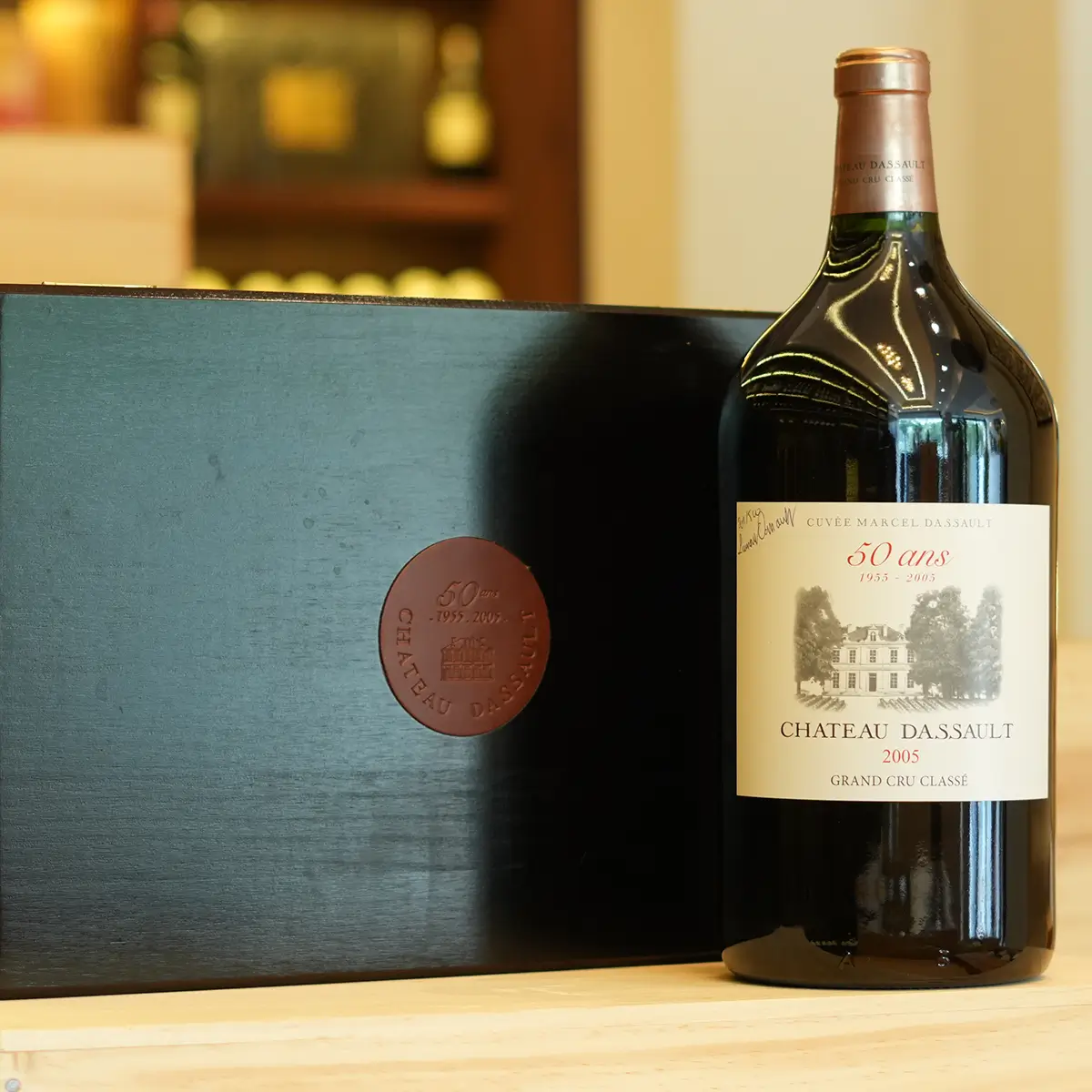
- Other “giant” bottles: Larger bottles such as Double Magnum (3L), Jeroboam (4.5L) or Imperial (6L) are almost always sold as individual bottles, usually presented elegantly in their own wooden boxes. They are too large, heavy and rare to be packed into multi-bottle cases.
Do you see the pattern here? Even when bottle count or bottle size changes, the total volume of 9 liters, equivalent to 12 standard 750ml bottles, remains an important reference point in the wine industry.
4. Wine case packaging formats by production region
This section explains in detail how different wine regions and wine styles have their own unique packaging traditions, going beyond the simple distinction between 12 and 6 bottles. This is essential for any professional sourcing wine globally.
4.1. Bordeaux wine tradition: Original Wooden Case (OWC)
Bordeaux is the historic center of the 12-bottle wooden case, often called OWC – Original Wooden Case. These wooden cases, often featuring branded artwork, are a signature of the region. Although 12-bottle OWCs still exist, especially for en primeur sales, 6-bottle wooden cases have become extremely popular for higher-end châteaux. Bordeaux also commonly produces 6-bottle magnum cases (1.5L) and rarer 24-bottle half-bottle cases (375ml).
4.2. Burgundy wine case standards: The impact of bottle shape
Burgundy wines also use both 12-bottle and 6-bottle cases. However, the classic Burgundy bottle is wider and has more gently sloping shoulders than a Bordeaux bottle. The main result is that it requires a slightly larger wooden case. A typical 12-bottle Burgundy case is longer than the equivalent Bordeaux case, around 20.5 inches compared with 19.5 inches, to accommodate the bottle shape. This seemingly minor detail is very important for racking and storage systems.
4.3. Wine cases from Italy, Spain and the New World
These regions have largely adopted the 6-bottle case as their standard, especially for export markets. Cardboard is the most common material, although premium producers, for example Super Tuscans such as Sassicaia or leading California wines such as Opus One, use branded 6-bottle wooden cases. Some California wineries are also known for producing premium 3-bottle gift cases.
4.4. Champagne and sparkling wine: The weight factor
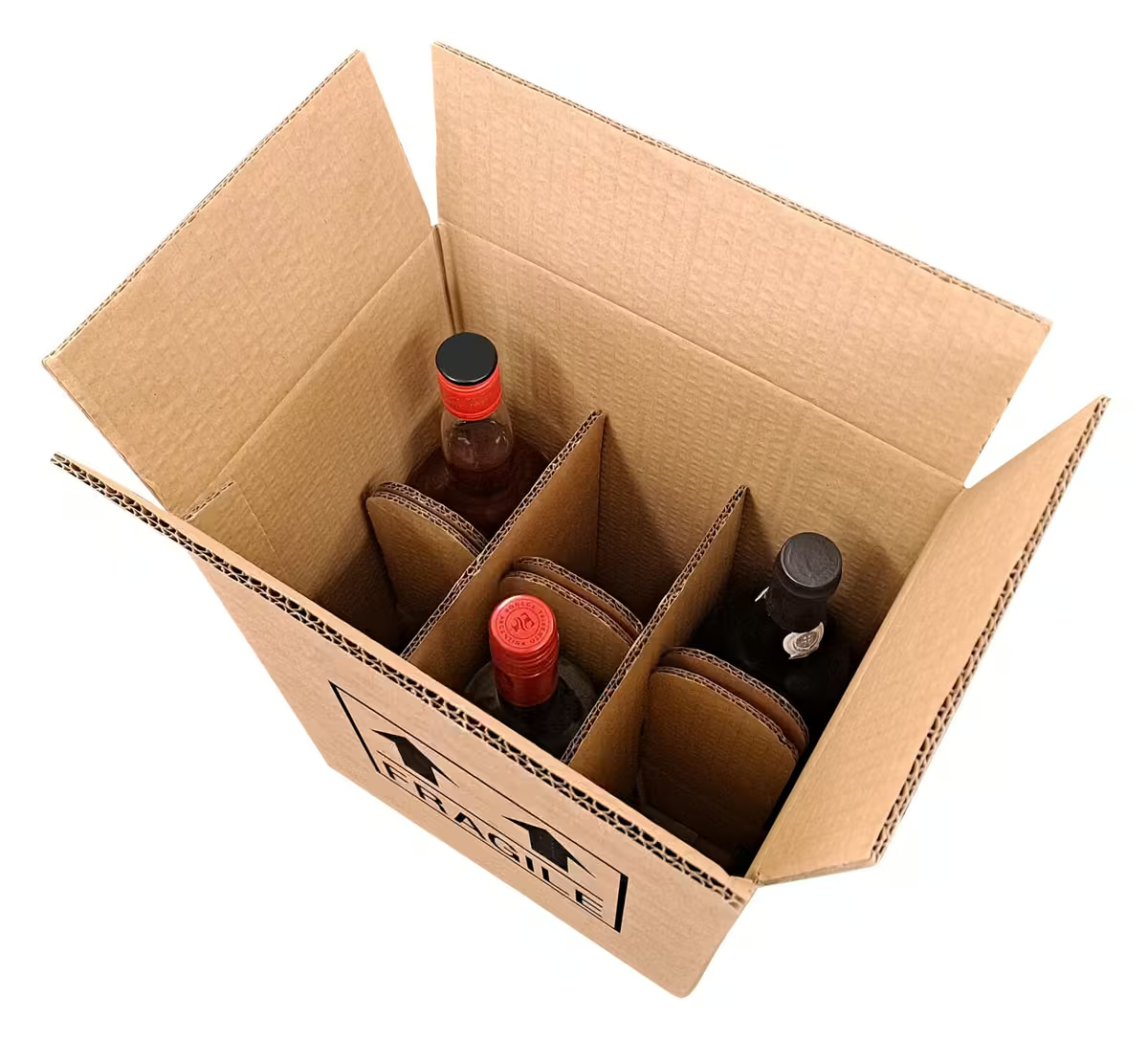
Champagne bottles are significantly heavier and thicker in order to withstand the internal pressure from carbonation. Because of this added weight and size, Champagne is almost universally sold in 6-bottle cases. A 12-bottle Champagne case would be extremely heavy, up to 25 kg, making it impractical.
Table: Comparative analysis of standard case configurations by region and wine type
| Region/Type | Number of wine bottles per case (750ml) | Common case material | Notes |
| Bordeaux | 12 (traditional), 6 (premium) | Wood (OWC) | 6-bottle magnum cases and 24-bottle half cases are also common. |
| Burgundy | 12, 6 | Wood, Cardboard | Cases are often longer than Bordeaux cases to fit wider bottles. |
| Champagne | 6 | Cardboard (reinforced) | Due to the heavier bottle weight. |
| Italy (Premium) | 6 | Wood, Cardboard | 6-bottle cases are standard for wines such as Barolo and Brunello. |
| Spain (Premium) | 6 | Wood, Cardboard | Common for exported wines. |
| California (Premium) | 6, 3 | Wood, Cardboard | 3-bottle cases are often used as gifts. |
| Australia/New Zealand | 12, 6 | Cardboard | 6-bottle cases are increasingly common for premium wines. |
| Vietnam market standard | 6 | Cardboard, Wood (gift cases) | 6 bottles are considered the “average” or popular format. |
Conclusion: So what is the answer?
In the modern world, a case of wine usually contains 6 bottles. This is the most common format today, especially for quality wines, because it makes pricing more approachable and is extremely convenient for transport and storage.
According to the traditional international standard, a case of wine contains 12 bottles. This number is a historical legacy, born from a clever mathematical solution for trade between France and England hundreds of years ago.
Ultimately, whether a case contains 6 or 12 bottles does not affect the quality of the wine inside. It is simply an interesting story about how the world of wine has developed and adapted to human needs over the centuries. Explore more quality wine bottles from Hedon WineHub!